
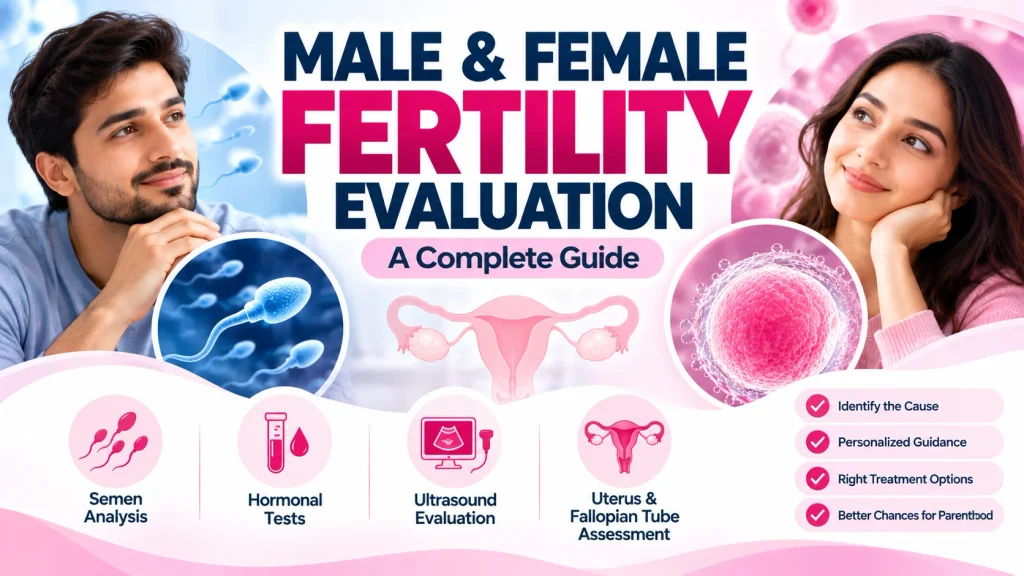
Male and Female Fertility Evaluation in Meerut: Tests, Causes and Treatment Options
Introduction
Planning a pregnancy is an important step in a couple’s life. However, some couples may experience difficulty conceiving naturally. In such situations, male and female fertility evaluation in Meerut can help identify possible reasons for delayed conception and guide couples toward appropriate treatment options.
Fertility evaluation involves assessing both partners’ reproductive health. It may include a review of medical history, physical examination, hormonal tests, semen analysis, ultrasound scans, and other investigations when medically indicated.
At Hope Maternity Home And Imaging Center, Meerut, couples can enquire about fertility consultation and the appropriate evaluation required for their individual needs.
What Is Fertility Evaluation?
Fertility evaluation is a medical assessment used to understand factors that may affect a couple’s ability to conceive. Since fertility can be influenced by both male and female factors, evaluating both partners is an important part of the process.
The evaluation helps a healthcare professional determine whether further investigations or fertility treatments may be appropriate.
Fertility assessment is generally recommended when:
- A woman under 35 has been trying to conceive for 12 months without success.
- A woman aged 35 or older has been trying for 6 months without success.
- A woman is over 40 and wishes to conceive.
- Either partner has a known condition that may affect fertility.
- There are irregular periods, a history of reproductive health problems, or concerns about sperm health.
Couples with known fertility concerns should consider seeking medical advice earlier rather than waiting for these time periods.
Male Fertility Evaluation in Meerut
Male fertility evaluation focuses on sperm production, sperm quality, reproductive health, and factors that may affect the ability to achieve pregnancy.
1. Medical History and Physical Examination
The doctor may ask about previous illnesses, surgeries, medications, lifestyle habits, sexual health, and the duration of attempts to conceive. A physical examination may be recommended depending on the patient’s symptoms and medical history.
2. Semen Analysis
Semen analysis is one of the most important initial tests for male fertility. It examines several characteristics of a semen sample, including:
- Sperm concentration: The number of sperm present.
- Sperm motility: How well sperm move.
- Sperm morphology: The shape and structure of sperm.
- Semen volume: The amount of semen produced.
An abnormal result does not automatically mean that natural conception is impossible. Semen parameters can vary, and a doctor may recommend repeating the test or conducting additional investigations.
3. Hormonal Testing
Blood tests may be recommended when a hormonal problem is suspected. Depending on the clinical situation, these may include testosterone, FSH, LH, and other relevant hormones.
4. Additional Investigations
Depending on the findings, the doctor may recommend a scrotal ultrasound, genetic testing, or other specialised investigations. These tests are not necessary for every patient and should be guided by medical assessment.
Female Fertility Evaluation in Meerut
Female fertility evaluation examines ovulation, ovarian function, the uterus, fallopian tubes, and other factors that may influence conception.
1. Menstrual History and Ovulation Assessment
The doctor may ask about menstrual cycle length, regularity, previous pregnancies, medical conditions, and the duration of attempts to conceive.
Irregular or absent periods may indicate that ovulation is not occurring regularly. Depending on the situation, the doctor may recommend blood tests or other methods to assess ovulation.
2. Hormonal Tests
Hormonal investigations may be advised based on symptoms, age, and medical history. These may include:
- AMH (Anti-Müllerian Hormone): Helps assess ovarian reserve.
- FSH and estradiol: May be measured at specific points in the menstrual cycle.
- Thyroid function tests: Recommended when thyroid problems are suspected or need assessment.
- Prolactin: May be tested when symptoms or menstrual changes suggest a possible problem.
No single hormone test can determine a woman’s complete fertility potential or guarantee whether she will conceive naturally.
3. Pelvic Ultrasound
A pelvic ultrasound helps assess the uterus, ovaries, and other pelvic structures. It may help identify conditions such as ovarian cysts, fibroids, or features associated with polycystic ovary syndrome (PCOS).
An ultrasound may also be used to assess the antral follicle count when clinically appropriate.
4. Fallopian Tube Assessment
Open fallopian tubes are important for natural conception. If indicated, the doctor may recommend a test such as hysterosalpingography (HSG) or another suitable investigation to assess tubal patency.
5. Uterine Evaluation
If symptoms or initial test results suggest a uterine problem, additional investigations may be recommended. These can include specialised ultrasound or hysteroscopy in selected cases.
Not every woman requires all these tests. The evaluation should be tailored to her medical history and initial findings.
Why Should Both Partners Be Evaluated?
Infertility can be associated with male factors, female factors, a combination of both, or an unexplained cause. Testing only one partner may delay the identification of relevant factors.
Evaluating both partners helps the doctor develop a more complete understanding of the couple’s reproductive health and recommend appropriate next steps.
What Happens After Fertility Evaluation?
Treatment depends on the findings, the couple’s preferences, age, duration of infertility, and other medical factors. Options may include:
- Lifestyle changes and advice on timing intercourse.
- Treatment for ovulation-related problems.
- Medication for specific hormonal conditions when indicated.
- Surgical treatment for selected reproductive conditions.
- Intrauterine insemination (IUI) in appropriate cases.
- In vitro fertilisation (IVF) or intracytoplasmic sperm injection (ICSI) when indicated.
Not every couple needs assisted reproductive treatment. Some may benefit from treating an underlying condition, while others may require further evaluation or specialist care.
How to Prepare for a Fertility Consultation
To make the consultation more useful, couples can:
- Bring previous medical reports and investigation results.
- Note the date of the last menstrual period and typical cycle length.
- Share details of previous pregnancies, miscarriages, surgeries, or fertility treatments.
- Prepare a list of current medicines and supplements.
- Follow the laboratory’s instructions before semen analysis or blood tests.
- Attend the consultation together when possible.
These steps can help the doctor understand the situation and avoid unnecessary repetition of tests.
Male and Female Fertility Evaluation at Hope Maternity Home, Meerut
If you and your partner are experiencing difficulty conceiving, a medical consultation can help determine which fertility investigations may be appropriate.
Hope Maternity Home And Imaging Center
Doctor: Dr. Seema Agarwal, M.B.B.S. & DGO
Address: 6, Bank Colony, Garh Road, Meerut, Uttar Pradesh, India
Contact: 9837032733 / 9422022401
Email: hopematernityhome@gmail.com
Website: hopefertilitymeerut.com
Contact the centre to enquire about fertility consultation, available diagnostic services, and the next steps for your individual situation. Please confirm the availability of specific tests and procedures directly with the centre.
Frequently Asked Questions (FAQs)
1. When should a couple undergo fertility evaluation?
Evaluation is generally recommended after 12 months of trying to conceive if the woman is under 35, or after 6 months if she is 35 or older. Earlier assessment may be appropriate when there are known fertility concerns or when the woman is over 40.
2. Is semen analysis necessary for male fertility evaluation?
Semen analysis is usually an important first-line investigation for assessing male fertility. The doctor may recommend additional tests depending on the results and medical history.
3. Which tests are commonly used for female fertility evaluation?
Depending on the clinical situation, evaluation may include menstrual history, ovulation assessment, hormonal blood tests, pelvic ultrasound, and tests to assess whether the fallopian tubes are open.
4. Does a normal AMH level guarantee pregnancy?
No. AMH provides information about ovarian reserve but does not independently predict whether a woman will conceive naturally. Age, ovulation, fallopian tube health, sperm parameters, and other factors also matter.
5. Can fertility problems be treated?
Many fertility-related conditions can be managed or treated. The suitable approach depends on the cause, age, medical history, and results of the evaluation.
6. Should both partners attend the fertility consultation?
When possible, yes. Fertility involves both partners, and a combined consultation can help ensure that relevant factors are assessed efficiently.
Conclusion
Male and female fertility evaluation is an important first step for couples who are having difficulty conceiving. A systematic assessment can help identify possible causes, guide further investigations, and support informed decisions about treatment.
If you are looking for fertility consultation in Meerut, speak with a qualified healthcare professional to understand which tests are suitable for you and your partner.
Medical Disclaimer: This article is for educational purposes only and does not replace a medical consultation, diagnosis, or personalised treatment advice. All tests and treatments should be recommended by a qualified healthcare professional.