
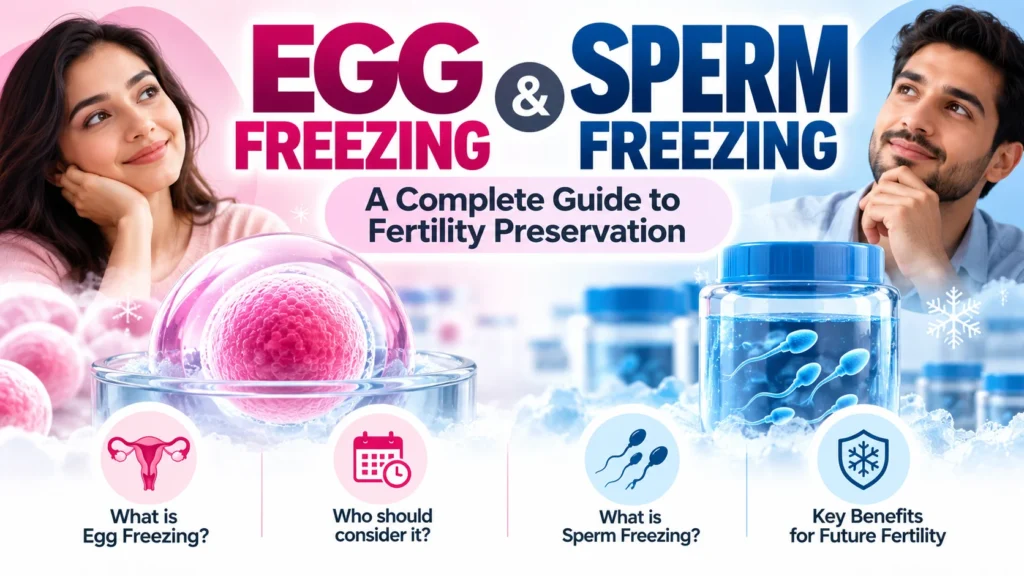
Egg Freezing and Sperm Freezing: Procedure, Benefits, Risks, and Cost
Hospital Name: Hope Maternity Home And Imaging Center
Doctor: Dr. Seema Agarwal (M.B.B.S. & D.G.O.)
Introduction: What Are Egg Freezing and Sperm Freezing?
Planning for the future is an important part of reproductive health. Some individuals may wish to preserve their fertility because they are not ready to have children, need medical treatment that could affect fertility, or want to explore future family-building options.
Egg freezing and sperm freezing are fertility preservation techniques that allow eggs or sperm to be collected, frozen, and stored for potential future use. These methods are also known as oocyte cryopreservation and sperm cryopreservation.
Egg freezing involves collecting mature eggs from the ovaries and preserving them at very low temperatures. Sperm freezing involves collecting a semen sample, preparing it in a laboratory, and storing sperm for possible future use.
When a person decides to use their frozen eggs or sperm, the reproductive cells can be thawed and used in an appropriate fertility treatment. Frozen eggs generally require fertilisation through IVF, often using ICSI, while frozen sperm may be used for IUI, IVF, or ICSI depending on the clinical circumstances.
At Hope Maternity Home And Imaging Center, located at 6, Bank Colony, Garh Road, Meerut, patients can consult Dr. Seema Agarwal (M.B.B.S. & D.G.O.) to discuss their reproductive health concerns and understand the available fertility preservation options.
What Is Egg Freezing?
Egg freezing is a procedure in which mature eggs are collected from the ovaries and stored for potential future use.
The process generally involves ovarian stimulation with fertility medications, ultrasound monitoring, and egg retrieval. The mature eggs are then frozen using a technique called vitrification, which cools them rapidly to help reduce the formation of damaging ice crystals.
The frozen eggs are stored in specialised cryogenic tanks at extremely low temperatures until they are needed.
Egg freezing may provide an opportunity to preserve eggs at a younger age, when egg quality is generally better. However, it does not guarantee a future pregnancy or live birth.
Who May Consider Egg Freezing?
Egg freezing may be considered by:
1. Individuals Delaying Parenthood
Some people wish to postpone having children because of education, career plans, personal circumstances, or not yet having a suitable partner.
2. Individuals Facing Medical Treatment
Certain cancer treatments, including some chemotherapy and radiation treatments, can affect ovarian function. Egg freezing may be an option before treatment when medically appropriate and when it can be arranged without an unsafe delay.
3. Individuals at Risk of Premature Ovarian Insufficiency
People with certain medical conditions or a family history associated with early loss of ovarian function may wish to discuss fertility preservation with a specialist.
4. Individuals Undergoing Certain Medical Procedures
Some treatments or surgeries involving the ovaries may affect future egg availability. Fertility preservation may be discussed before such procedures.
5. Individuals Exploring Fertility Preservation
People who want to understand their reproductive options may seek counselling about egg freezing, its limitations, and alternative approaches.
The suitability of egg freezing depends on age, ovarian reserve, medical history, personal preferences, and the expected number of mature eggs that can be collected.
What Is Sperm Freezing?
Sperm freezing is a fertility preservation procedure in which sperm are collected, processed, and stored at very low temperatures for possible future use.
The process is also called sperm cryopreservation. It can help preserve reproductive options for people who may face reduced fertility in the future.
A semen sample is usually collected in a designated room at a fertility facility. The laboratory evaluates the sample and prepares it for freezing. In selected cases, sperm may be retrieved surgically and preserved.
Frozen sperm is stored in specialised cryogenic tanks and can be thawed when required for an appropriate fertility treatment.
Although freezing can preserve sperm for future use, not all sperm survive freezing and thawing, and successful fertilisation or pregnancy cannot be guaranteed.
Who May Consider Sperm Freezing?
1. Individuals Facing Cancer Treatment
Some chemotherapy and radiation treatments can damage sperm production. Sperm freezing before treatment may preserve future reproductive options.
2. Individuals Planning a Vasectomy
People considering a vasectomy may wish to discuss sperm freezing before the procedure if they want to preserve the possibility of biological parenthood in the future.
3. Individuals With Certain Medical Conditions
Medical conditions or planned procedures that may affect sperm production or reproductive function can make fertility preservation worth discussing.
4. Individuals With Occupational or Medical Risks
People who anticipate treatment or exposure that may affect fertility may consider sperm banking after appropriate medical counselling.
5. Individuals With Changing Reproductive Plans
Some people choose to preserve sperm before circumstances change. The decision should include an understanding of storage arrangements, costs, and the limitations of future use.
How Does Egg Freezing Work? Step-by-Step Procedure
Step 1: Fertility Consultation
The process begins with a consultation to review medical history, age, menstrual cycles, previous surgeries, medications, and future reproductive plans.
The doctor may recommend blood tests and an ultrasound to assess ovarian reserve and help estimate how the ovaries may respond to stimulation.
Ovarian reserve tests can provide useful information, but they cannot precisely predict future natural fertility or guarantee the number of eggs that will be collected.
Step 2: Ovarian Stimulation
Fertility medications are used for a period of several days to stimulate the ovaries to develop multiple follicles.
The response is monitored through ultrasound scans and, when necessary, blood tests. Medication doses may be adjusted according to the patient’s response.
The aim is to obtain suitable mature eggs while reducing the risk of complications.
Step 3: Trigger Medication
When the follicles have developed sufficiently, a trigger medication is given to support final egg maturation.
Egg retrieval is carefully scheduled according to the treatment protocol.
Step 4: Egg Retrieval
Egg retrieval is generally performed under ultrasound guidance using a specialised needle. Sedation or anaesthesia is provided as appropriate.
The procedure allows the doctor to collect eggs from the developed follicles. The number of eggs collected varies according to age, ovarian reserve, and response to stimulation.
Step 5: Egg Assessment and Freezing
The collected eggs are assessed in the embryology laboratory. Mature eggs suitable for preservation are frozen, usually through vitrification.
The eggs are stored in specialised cryogenic tanks under carefully controlled conditions.
Step 6: Storage and Future Use
The frozen eggs remain stored until the individual decides to use them, subject to applicable laws, consent requirements, and storage policies.
When future pregnancy is desired, the eggs can be thawed and fertilised using IVF, often with ICSI. Any resulting embryos are monitored, and an appropriate embryo may be transferred into the uterus.
Not every egg survives thawing or fertilises successfully, and not every resulting embryo leads to pregnancy.
How Does Sperm Freezing Work? Step-by-Step Procedure
Step 1: Initial Consultation
The doctor reviews medical history, fertility goals, planned treatments, and any relevant reproductive health concerns.
Depending on the circumstances, semen analysis and infection screening may be recommended.
Step 2: Sperm Collection
A semen sample is usually collected through masturbation into a sterile container in a designated private room.
If sperm collection is difficult or a medical condition prevents sperm from being obtained in this way, the doctor may discuss alternative options.
Step 3: Laboratory Assessment
The laboratory evaluates the sample, including sperm count, movement, and other relevant characteristics.
The findings help determine how the sample should be prepared and stored.
Step 4: Sample Preparation and Freezing
The semen sample is prepared using an appropriate laboratory protocol and mixed with a cryoprotective medium to help protect sperm during freezing.
The sample is divided into labelled storage containers or straws and frozen using the laboratory’s validated method.
Step 5: Cryogenic Storage
The frozen sperm is stored in specialised cryogenic tanks at very low temperatures, with systems and procedures designed to maintain sample identification and storage integrity.
The laboratory maintains records and follows applicable safety, monitoring, and consent requirements.
Step 6: Future Use
When needed, the sperm sample is thawed and assessed. Depending on the sample quality and the couple’s fertility assessment, it may be used for IUI, IVF, or ICSI.
The appropriate method depends on the number of usable sperm after thawing and other reproductive factors.
What Are the Benefits of Egg and Sperm Freezing?
Fertility preservation may offer several potential benefits.
1. Preserving Reproductive Options
Freezing eggs or sperm can preserve reproductive cells for possible future use, which may be particularly important before treatments that could affect fertility.
2. Planning for Future Parenthood
Egg or sperm freezing may provide additional reproductive options for people who are not ready to try for pregnancy now.
3. Preserving Eggs at a Younger Age
Egg quality generally declines with age. Freezing eggs at a younger age may preserve eggs with the characteristics they had at the time of freezing.
However, the number of eggs collected and the age at freezing strongly influence the potential outcome.
4. Fertility Preservation Before Medical Treatment
For some patients facing cancer treatment or other fertility-affecting medical procedures, freezing eggs or sperm before treatment may be an important part of reproductive planning.
Urgent medical care should not be delayed without advice from the treating medical team.
5. Flexibility in Future Treatment
Frozen eggs or sperm may be used in a future fertility treatment cycle, depending on medical suitability, legal requirements, and storage arrangements.
What Are the Limitations of Egg and Sperm Freezing?
Although fertility preservation can be valuable, it has important limitations.
- Freezing does not guarantee a future pregnancy or live birth.
- Not all eggs survive thawing, fertilise successfully, or develop into embryos.
- Not all sperm survive freezing and thawing with sufficient function for the intended treatment.
- The number and quality of eggs or sperm available affect future treatment options.
- Egg freezing requires medication, monitoring, and an egg retrieval procedure.
- Storage involves ongoing costs and consent requirements.
- Future pregnancy depends on additional factors, including the health of the person carrying the pregnancy and the success of fertility treatment.
Patients should receive clear counselling about realistic expectations before deciding to freeze eggs or sperm.
What Is the Best Age for Egg Freezing?
Age is an important factor in egg freezing because egg quantity and quality generally decline over time.
Freezing eggs at a younger age often provides better prospects than freezing them at an older age. However, there is no single age that is ideal for every individual.
A fertility specialist may consider:
- Current age
- Ovarian reserve assessment
- Medical history
- Family-building plans
- The likely number of eggs that may be collected
- The potential need for more than one stimulation cycle
Tests such as anti-Müllerian hormone (AMH) and antral follicle count may help estimate ovarian response, but they do not directly measure egg quality or guarantee future fertility.
A consultation can help individuals understand their options without assuming that everyone needs egg freezing.
How Long Can Eggs and Sperm Remain Frozen?
Eggs and sperm can be stored for extended periods under appropriate cryogenic conditions. However, the permitted storage duration, consent requirements, renewal procedures, and rules for future use depend on applicable laws, regulations, and facility policies.
Patients should confirm storage terms, fees, documentation requirements, and procedures for renewing consent directly with the fertility facility.
The length of time a sample remains frozen does not, by itself, guarantee a successful future pregnancy.
What Is the Cost of Egg Freezing and Sperm Freezing in Meerut?
The cost of fertility preservation in Meerut varies depending on the type of procedure, investigations, medications, laboratory services, and storage duration.
Factors Affecting Egg Freezing Cost
- Initial consultation and fertility investigations
- Ovarian reserve tests and ultrasound scans
- Ovarian stimulation medications
- Monitoring appointments
- Egg retrieval and anaesthesia or sedation
- Laboratory egg assessment and freezing
- Annual or periodic storage charges
- Future thawing, fertilisation, and embryo transfer costs
Factors Affecting Sperm Freezing Cost
- Initial consultation and semen analysis
- Recommended screening tests
- Sperm collection and laboratory preparation
- Freezing and sample storage
- Ongoing storage fees
- Future thawing and fertility treatment costs
The total expense depends on individual requirements and the facility’s applicable charges.
At Hope Maternity Home And Imaging Center, patients can contact the clinic to enquire about consultation arrangements and available fertility services. Ask for a clear breakdown of procedure charges, storage fees, renewal requirements, and future-use costs before proceeding.
Egg Freezing vs Sperm Freezing: What Is the Difference?
Egg Freezing
- Involves collecting mature eggs from the ovaries.
- Usually requires ovarian stimulation and an egg retrieval procedure.
- Requires laboratory assessment and cryogenic storage.
- Frozen eggs generally require IVF, often with ICSI, for future use.
Sperm Freezing
- Usually involves collecting a semen sample.
- Does not require ovarian stimulation or egg retrieval.
- Requires laboratory assessment, preparation, and cryogenic storage.
- Frozen sperm may be used for IUI, IVF, or ICSI, depending on clinical suitability.
Both procedures aim to preserve reproductive cells for possible future use, but they differ in complexity, cost, medical requirements, and the factors that influence future outcomes.
Are There Any Risks or Side Effects?
Risks of Egg Freezing
Egg freezing involves ovarian stimulation and egg retrieval. Possible risks include:
- Temporary bloating, abdominal discomfort, or headaches related to medication
- Ovarian hyperstimulation syndrome
- Bleeding or infection related to egg retrieval
- Rare injury to nearby structures
- Risks associated with sedation or anaesthesia
The treating doctor should explain the risks and how monitoring helps reduce complications.
Risks and Limitations of Sperm Freezing
Sperm collection and freezing are generally straightforward procedures, but limitations include:
- Some sperm may not survive freezing and thawing.
- Sperm movement may be reduced after thawing.
- The original sample may contain a limited number of usable sperm.
- Additional samples may be recommended in some circumstances.
- Storage errors or equipment problems are rare but important risks addressed through laboratory safety systems.
Patients should discuss sample suitability, storage arrangements, and backup procedures with the laboratory.
Frequently Asked Questions About Egg and Sperm Freezing
1. Does egg freezing guarantee pregnancy?
No. Egg freezing preserves eggs for possible future use, but it does not guarantee fertilisation, embryo development, pregnancy, or live birth.
2. Is egg freezing painful?
Ovarian stimulation may cause temporary bloating or discomfort. Egg retrieval is generally performed with appropriate sedation or anaesthesia, so the experience varies according to the individual and the procedure.
3. Is sperm freezing painful?
Sperm freezing through a semen sample usually does not involve a surgical procedure. If sperm must be retrieved surgically, the procedure and recovery depend on the technique used.
4. Can frozen eggs be used after several years?
Frozen eggs may be used in the future, subject to storage conditions, applicable regulations, and consent requirements. Outcomes depend on factors such as age at freezing, the number of mature eggs stored, and the results of subsequent fertility treatment.
5. Can frozen sperm be used for IVF?
Yes. Frozen sperm may be used for IVF or ICSI, depending on the sample quality and clinical circumstances. It may also be suitable for IUI in selected cases.
6. How many eggs should be frozen?
There is no universal number. The number of eggs that may be recommended depends on age, ovarian reserve, future family-building goals, and the expected likelihood of success. A fertility specialist can discuss realistic expectations.
7. Is fertility preservation suitable for everyone?
No. The decision depends on medical history, age, reproductive goals, potential benefits, costs, and individual circumstances. Counselling helps patients decide whether fertility preservation is appropriate.
8. Should egg or sperm freezing be considered before cancer treatment?
It may be appropriate for some patients. When possible, fertility preservation should be discussed promptly with the oncology and reproductive medicine teams before treatment begins. Necessary cancer treatment should not be delayed without agreement from the treating clinicians.
Why Consult Hope Maternity Home And Imaging Center?
Fertility preservation involves medical, emotional, and financial considerations. Understanding the procedure, likely outcomes, storage arrangements, and future treatment options can help patients make informed decisions.
At Hope Maternity Home And Imaging Center, Meerut, patients can consult Dr. Seema Agarwal (M.B.B.S. & D.G.O.) to discuss reproductive health concerns and understand whether a fertility consultation or referral for specialist fertility preservation services may be appropriate.
The available procedures and laboratory services should be confirmed directly with the clinic before making treatment arrangements.
Book a Fertility Consultation in Meerut
If you are considering egg freezing or sperm freezing, seek medical guidance to understand the available options and their suitability for your circumstances.
Hospital Name: Hope Maternity Home And Imaging Center
Doctor: Dr. Seema Agarwal (M.B.B.S. & D.G.O.)
Address: 6, Bank Colony, Garh Road, Meerut, Uttar Pradesh, India
Contact Numbers: 9837032733, 9422022401
Email: hopematernityhome@gmail.com
Contact the clinic to enquire about a consultation and discuss your reproductive health goals.
Medical Disclaimer: This article is for general educational purposes and is not a substitute for professional medical advice, diagnosis, or treatment. Fertility preservation options, suitability, risks, and future outcomes should be discussed with a qualified medical professional.